Last updated: November 2026
Insurance brokers can use AI to take over repetitive tasks such as manual data entry, inbox sorting, renewal reminders, document chasing and insurer portal filling. The broker stays in charge of advice, placement and anything client-facing. AI won’t replace insurance brokers, but brokers who use it will have far more time for clients than those who don’t.
Key takeaways
- AI won’t replace insurance brokers. Clients want a person, especially when a claim goes wrong. Brokers who ignore AI risk falling behind the ones who use it.
- The biggest time savings come from repetitive tasks: data entry, renewals, document chasing, inbox triage and insurer portals.
- Start with one area of the brokerage, get three use cases working well, then scale.
- Use automation for fixed steps and AI agents for tasks that need judgement. A person approves anything that reaches a client.
- The FCA isn’t writing new AI rules. Consumer Duty, SM&CR and UK GDPR already apply to how you use AI.
How insurance brokers can use AI in 7 steps
- Audit the brokerage. Go through each area: sales, marketing, onboarding, servicing, renewals, claims and admin. Note how long each task takes.
- Map your processes. Break each workflow into its smallest steps. The repetitive, manual processes stand out quickly.
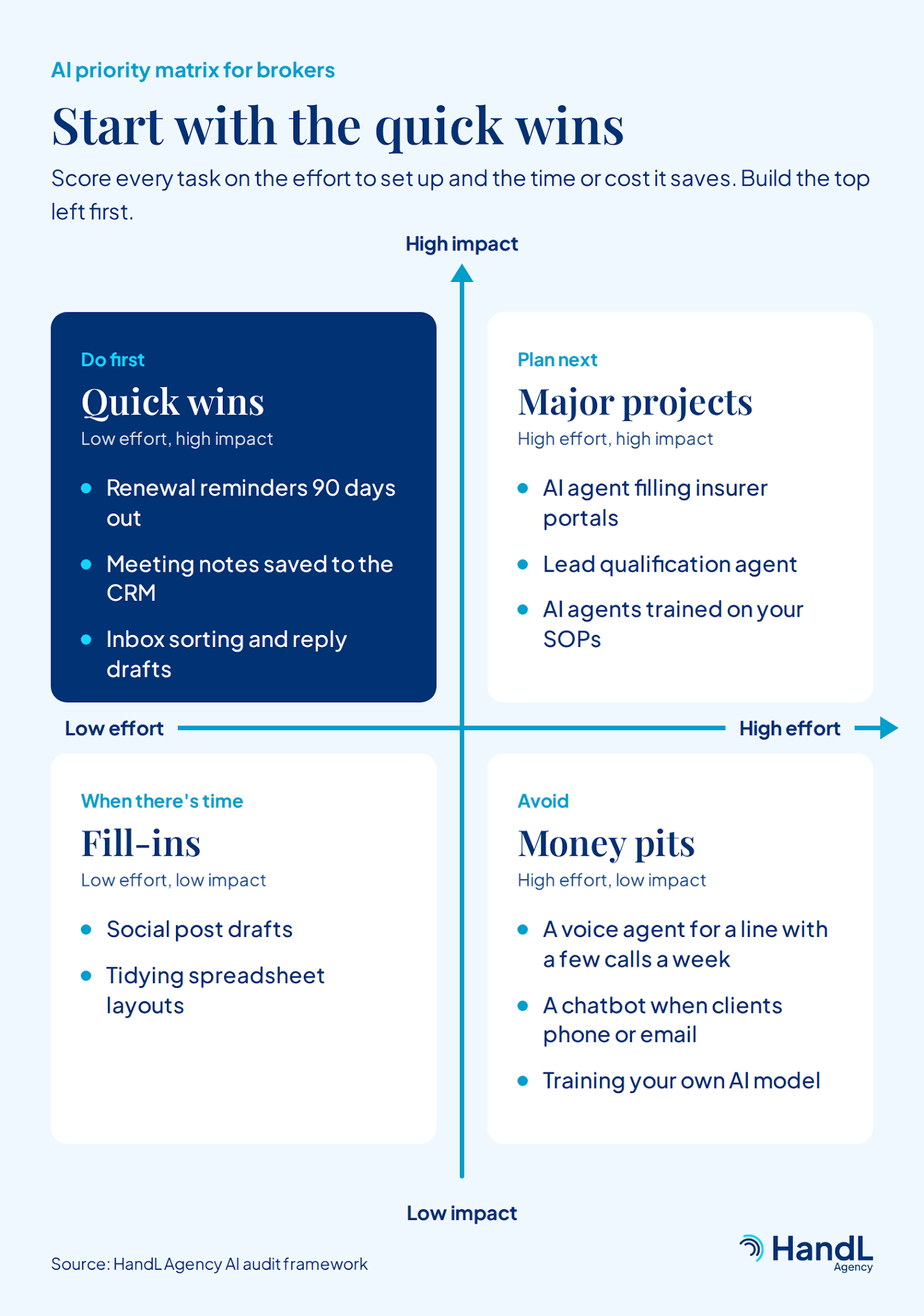
- Score every task on effort and impact. Start with quick wins: low effort to set up, high impact on time or cost.
- Use automation first, AI second. If a task follows the same steps every time, automate it. Save AI agents for tasks that need judgement.
- Choose business-grade AI tools. Use plans that don’t train on your client data, and write a one-page AI policy.
- Keep a person in charge. AI drafts, sorts and fills in. A broker approves, sends and submits.
- Get one process right, then scale. Make sure the whole team uses it before you move on to the next.
The first 30 days is an audit. We go through every area of the brokerage, map the current processes and how long each one takes, then work out how much time AI can save. From there we build a roadmap in priority order, from quick wins to major projects, and work through it one process at a time.
Bailey Wilshire, HandL Agency
Why are insurance brokers turning to AI now?
Insurance brokers are turning to AI because admin is growing faster than brokerages can hire. Brokers sit at the centre of UK commercial insurance. BIBA represents more than 1,700 regulated firms employing over 130,000 people, and brokers arrange around £150bn of general insurance premiums. A 2026 report put brokers’ share of UK commercial insurance at 94%.
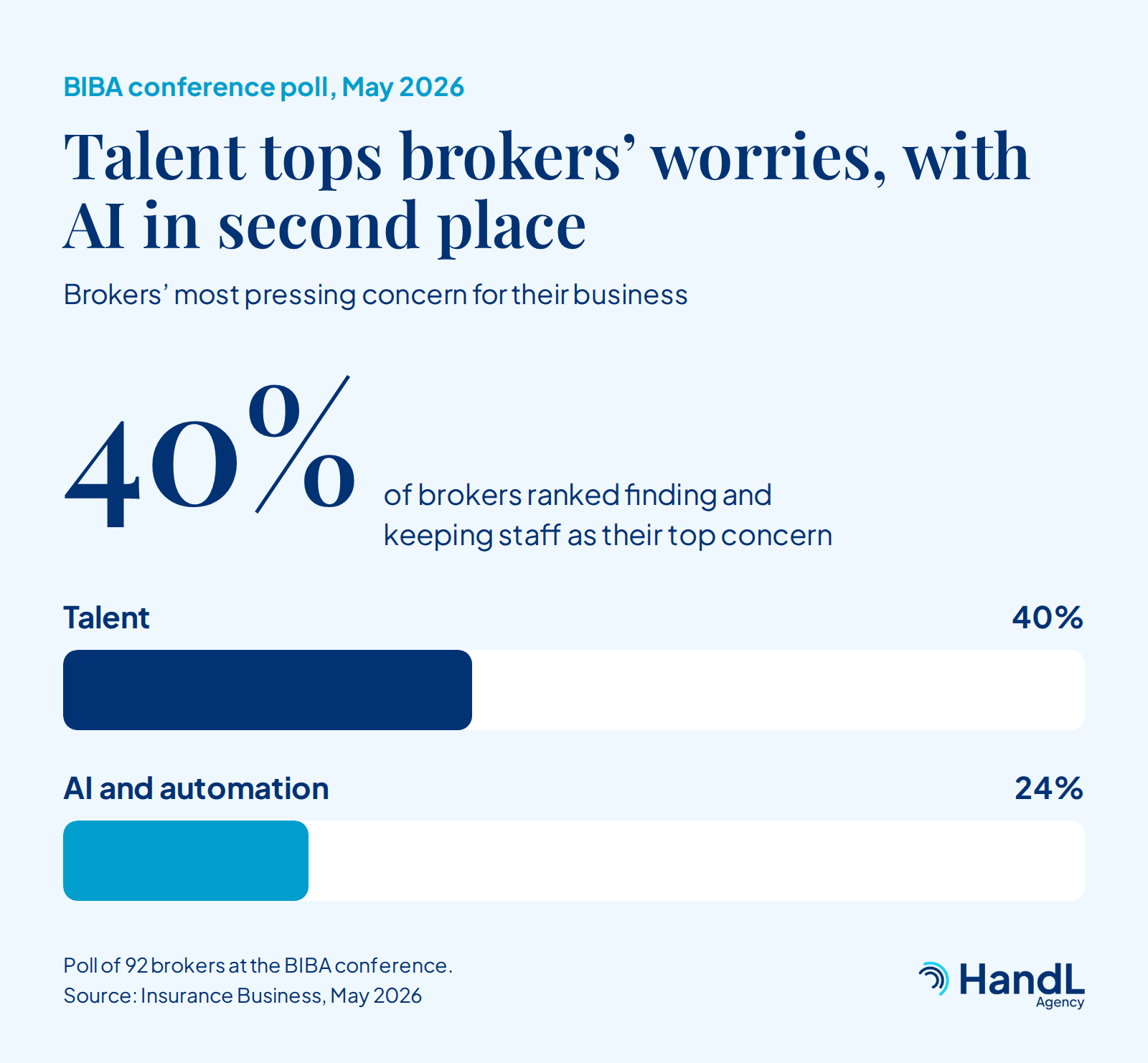
That workload lands on teams that are hard to grow. In a poll of 92 brokers at the BIBA conference in May 2026, 40% ranked finding and keeping staff as their most pressing concern. AI and automation came second at 24%. Regulation adds to the load too: BIBA and London Economics research found regulation costs equal 5.2% of premiums collected, with 3.3% falling on brokers.
From the brokers I speak to, opinions on AI are mixed. Some are excited and already using it. Some are nervous but giving it a go because they know AI is here to stay. Some worry it will take their jobs, and a few refuse to touch it.
Most brokers using AI today use ChatGPT or Claude to rewrite emails and do research. That’s the tip of the iceberg. Very few have automated their processes or set up AI agents, so most haven’t seen what AI can do with the boring, repetitive data entry that fills their day.
The US is further along. The 2026 Big “I” Agents Council for Technology report found roughly two-thirds of independent US agencies already use AI in some form, with a similar share planning to expand their use over the next 12 months.
Will AI replace insurance brokers?
No. AI won’t replace insurance brokers, because clients want to deal with a person, especially when something has gone wrong. What AI replaces is the admin that keeps brokers from those clients.
People want to deal with people, especially when it’s their money on the line and something has gone wrong. Nobody making a claim wants to explain it to a chatbot. They want someone who knows them to pick up the phone and walk them through it.
Bailey Wilshire

UK trade press reached the same conclusion. An Insurance Times briefing in February 2026 argued that for commercial brokers, AI is far more likely to be an opportunity than an existential risk, and one that will widen the gap between winners and laggards. It also noted that if AI influences coverage recommendations, brokers remain accountable.
Large insurers are building the same way. Under its January 2026 partnership with Anthropic, Allianz made Claude part of its internal AI platform, and its human-in-the-loop principle means employees take over sensitive or complex claims to make sure they’re handled with empathy.
Should UK brokers be worried about AI insurance apps in ChatGPT?
UK brokers shouldn’t panic, but they should pay attention. When two AI insurance apps went live inside ChatGPT on 9 February 2026, WTW fell 12%, Aon 9.3% and Arthur J. Gallagher 9.9% in a single session, and Bank of America estimated $15 billion of low-complexity commissions at risk.
The detail matters. The apps quoting inside ChatGPT handle simple, single-product personal lines, while a business needing several covers still needs a broker with access to multiple insurers and placement expertise. Commercial broking is safe from that kind of app for now. A broker who only competes on processing paperwork is not.
If you’re only getting by doing admin and giving clients a poor experience, you’re going to suffer. AI is getting better at admin all the time.
Bailey Wilshire
What can a broker do that AI can’t?
AI can’t:
- Build trust with a client over years
- Read a nuanced commercial risk and know which insurer will take it
- Negotiate terms with insurers
- Guide a stressed client through a claim
- Spot the cover a client needs but doesn’t know to ask for
- Take accountability for the advice
What happens to insurance brokers who ignore AI?
Insurance brokers who ignore AI will gradually fall behind. Their teams will be stretched across the same admin, response times will slip, and clients will move to brokers who answer the phone.
The brokerages using AI well will grow without hiring at the same rate. Overheads fall, margins improve, and brokers get time back for the consultative side of the job: walking clients through renewals, explaining cover and supporting them through claims. That helps retention, and retention is what a brokerage lives on.
The gap is already visible among insurers. McKinsey’s research found that over five years, the insurance sector’s AI leaders created 6.1 times the total shareholder return of AI laggards, compared with two to three times in most other sectors.
What’s the difference between AI in insurance and AI for insurance brokers?
AI in insurance mostly describes what insurers do: underwriting and claims management, pricing and fraud detection. AI for insurance brokers is about the work brokers do: client communications, submissions, renewals and admin. Brokers don’t run insurer systems, but they feel the effects.
| Insurer-side AI | Broker-side AI | |
|---|---|---|
| Main jobs | Underwriting, risk modelling, pricing, claims processing, fraud detection | Admin, client communications, submissions, renewals, claims tracking |
| How it works | Machine learning models trained on claims data and claims history | AI assistants, automations and AI agents connected to the CRM and inbox |
| Examples | Predictive analytics forecasting claims, flagging suspicious claims, reading medical records for life cover | Drafting renewal letters, chasing documents, filling insurer portals |
The insurer-side results show what’s possible. UK insurer Aviva put more than 80 AI models to work in claims, cutting liability assessment time on complex cases by 23 days, improving routing accuracy by 30% and reducing customer complaints by 65%. Aviva said transforming motor claims saved more than £60 million in 2024.
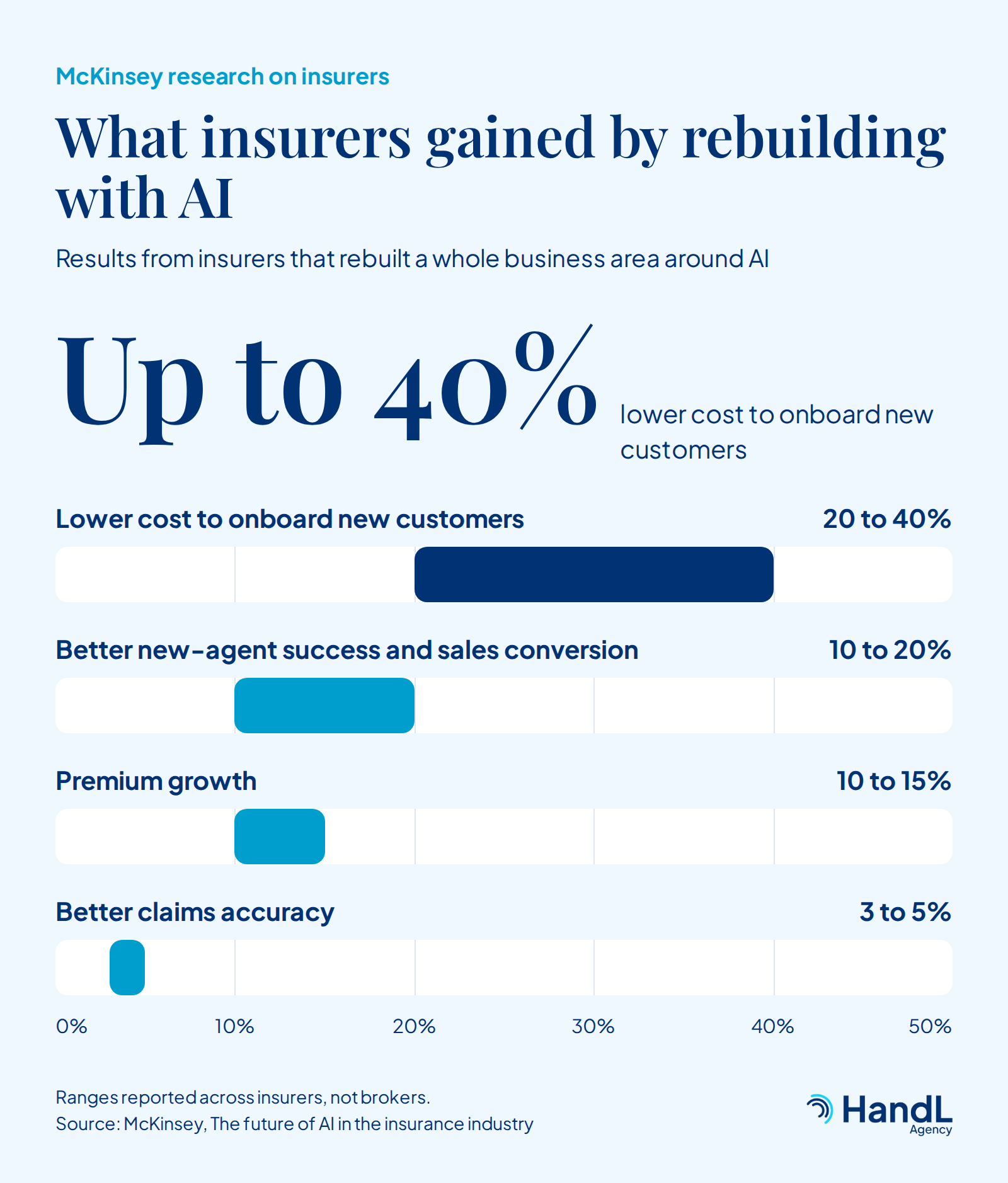
McKinsey found that insurers rebuilding whole business areas around AI saw 10 to 20% improvements in new-agent success and sales conversion, 10 to 15% premium growth, 20 to 40% lower costs to onboard new customers, and a 3 to 5% improvement in claims accuracy.
What are AI assistants, automations and AI agents?
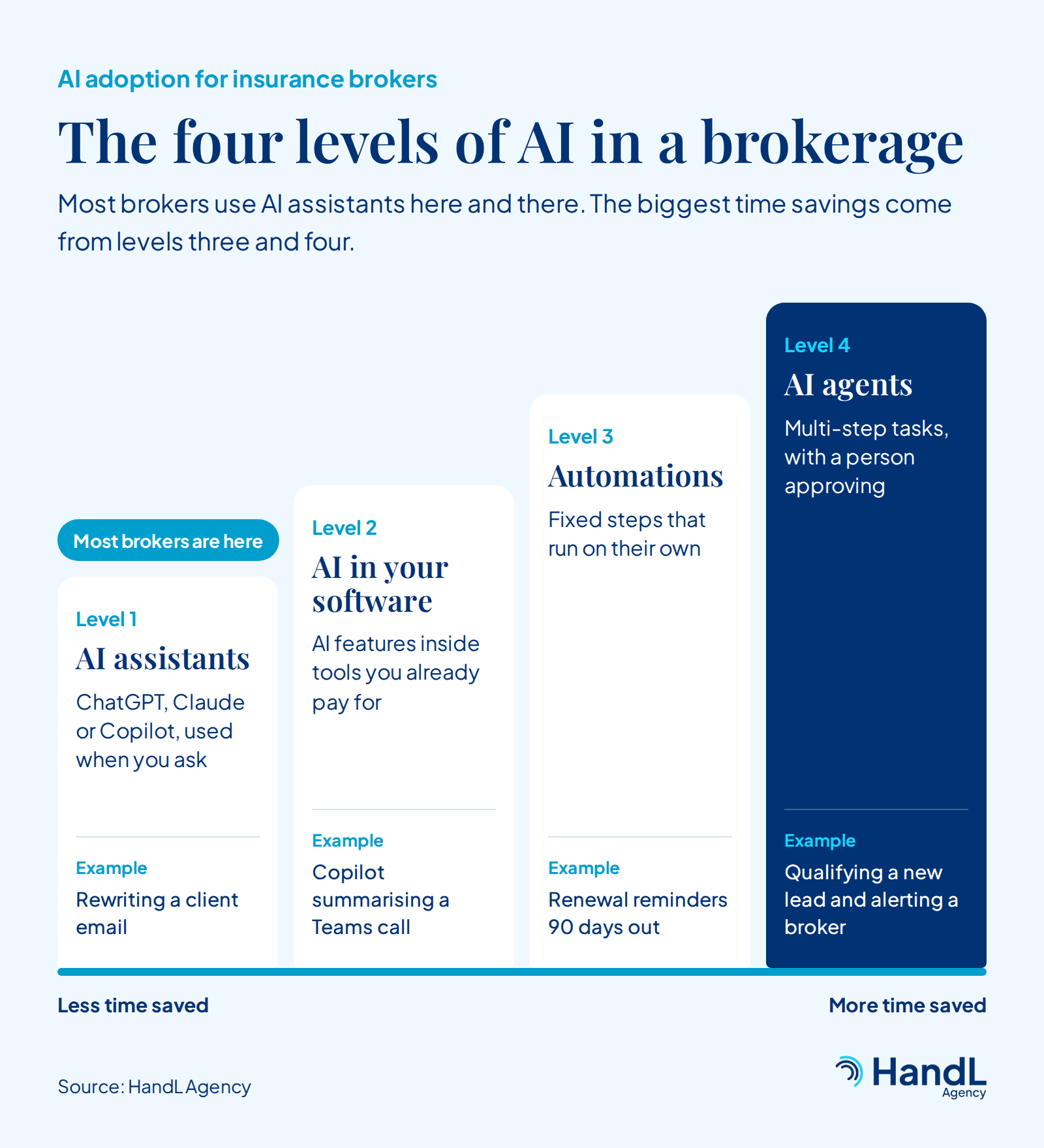
These are the three types of AI tool a broker will come across. The difference is how much judgement each one uses.
- An AI assistant is a generative AI tool such as ChatGPT, Claude or Microsoft Copilot. It uses natural language processing to read and write text when you ask it to.
- An automation runs the same fixed steps every time. A renewal reminder 90 days before the renewal date is simple date logic. No AI needed.
- An AI agent takes a goal, makes decisions and carries out several steps across your systems. This is agentic AI: it can read an email, update the CRM and draft a reply, then stop for a person to approve.
| Automation | AI assistant | AI agent | |
|---|---|---|---|
| What it does | Runs fixed steps on a trigger | Answers and drafts when asked | Completes multi-step tasks across systems |
| Judgement | None | Some, one task at a time | Yes, within rules you set |
| Broker example | Renewal reminder at 90 days | Summarise a policy schedule | Qualify a new lead, tag it in the CRM and alert the right broker |
| Who approves | Set up once | The user, every time | A person at set checkpoints |
If a task runs the same way from start to finish every time, it’s an automation. You only need AI when the task needs some judgement, and that’s where an AI agent comes in.
Bailey Wilshire
Agentic AI in insurance broking works best when the AI agents are joined up. After a sales call, for example, an agent can save the transcript, match it to the right lead, write the notes, tag the lead and move it to the right stage in the CRM. Each AI agent handles one job, and the broker reviews the result.
How can insurance brokers use AI across the brokerage?
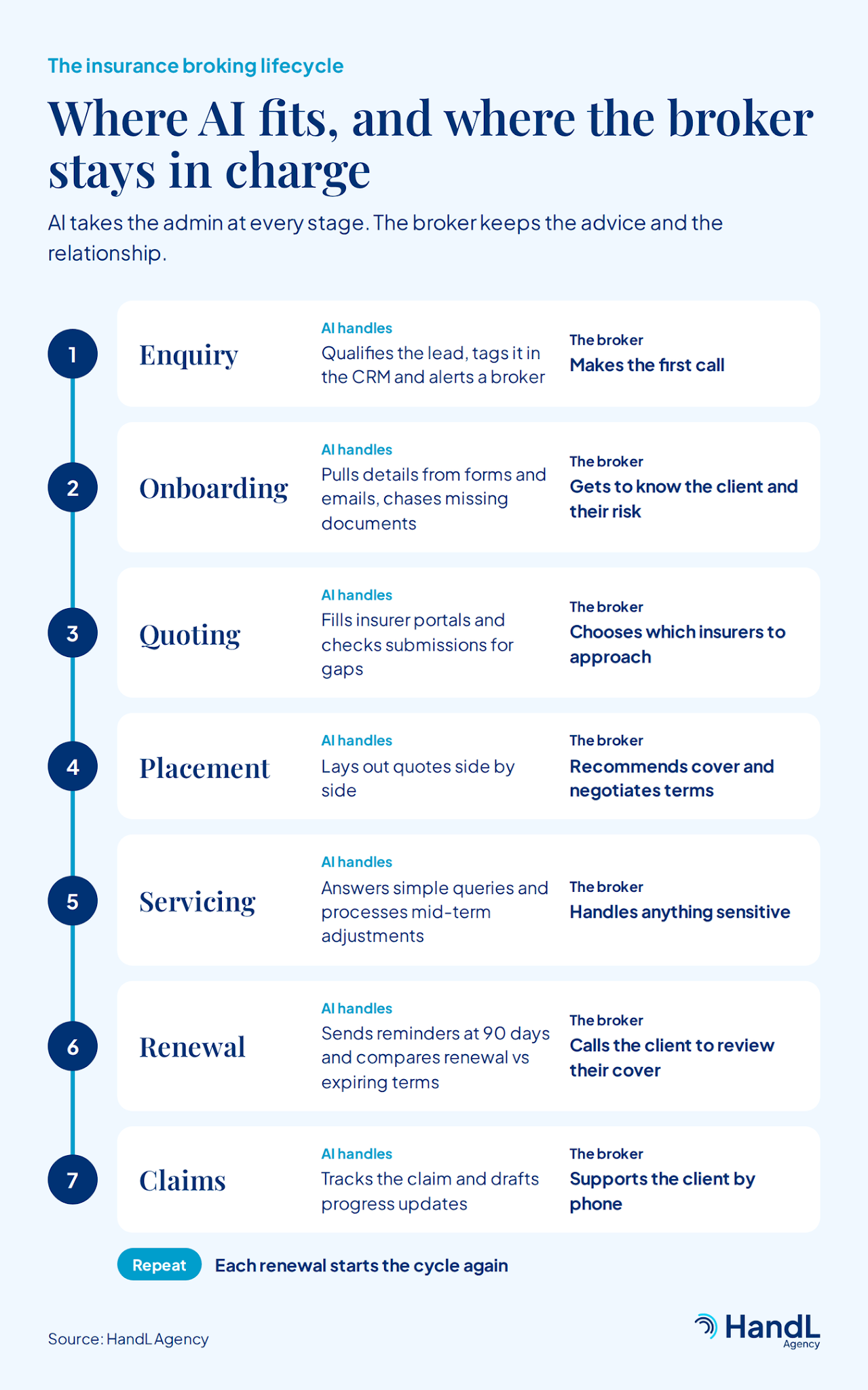
Insurance brokers can use AI at every stage of the client lifecycle, from first enquiry to claim. Here’s where it fits.
Lead generation and speed to lead
AI can capture every enquiry, qualify it and get it to the right broker in seconds. Leads from ads, landing pages, the website and social forms all land in the CRM, and an AI agent scores them against your ideal client profile, tags them and alerts the right broker for a warm handover. Conversational AI on the website can answer routine questions 24/7 and pass the conversation on.
Speed matters. Research covering 1.25 million leads, published in Harvard Business Review, found firms that contacted leads within an hour were nearly seven times more likely to qualify them than firms that waited an hour longer.
AI qualifies. A person closes the sale. For a ready-made version, our lead research automation researches every new enquiry and sends a briefing to the broker within minutes.
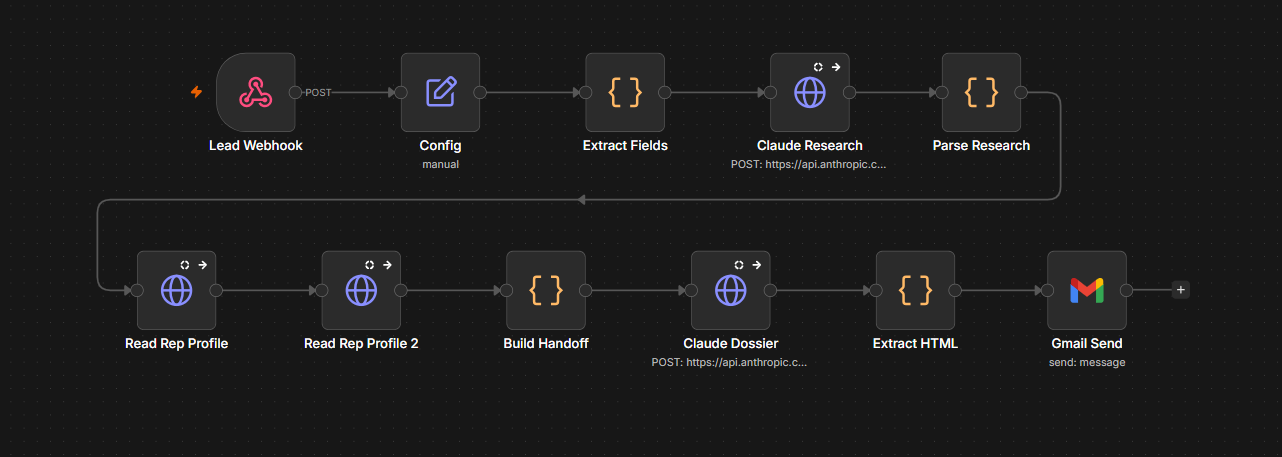
A HandL Agency lead research workflow. Most steps are fixed automation. AI is only used where judgement is needed: researching the enquiry and writing the broker’s briefing.
Quoting, submissions and insurer portals
AI cuts the re-keying that slows quoting down. Natural language processing extracts client details from unstructured emails, forms and call transcripts. AI can check a submission for missing information before it reaches an underwriter, and match the risk to insurer appetite notes, which cuts the back and forth.
Insurer portals are where brokers lose the most time. With Claude in Chrome, an AI agent can fill an insurer portal step by step:
- Take the client’s details from an email, notes or proposal form
- Open the portal and read the real fields on screen
- Match each piece of data to the right field by its label
- Handle multi-page forms and logins
- Stop at the submit button and flag anything missing for the broker
The broker checks and submits every quote. If a required field has no matching data, the AI stops and asks rather than guessing. AI prepares the quote. It never chooses the cover.
Renewals
AI makes sure no renewal is left to the last minute. An automation creates reminders 90 days out and blocks time to call the client. AI then drafts renewal notices, compares renewal terms against expiring terms, and builds a prioritised action list for the week.
Every hour AI saves should go straight back into the client. Ring them 90 days before renewal, check they’re happy, and talk them through the cover they need. That’s the part of the job AI can’t do.
Bailey Wilshire

Claims updates and claims tracking
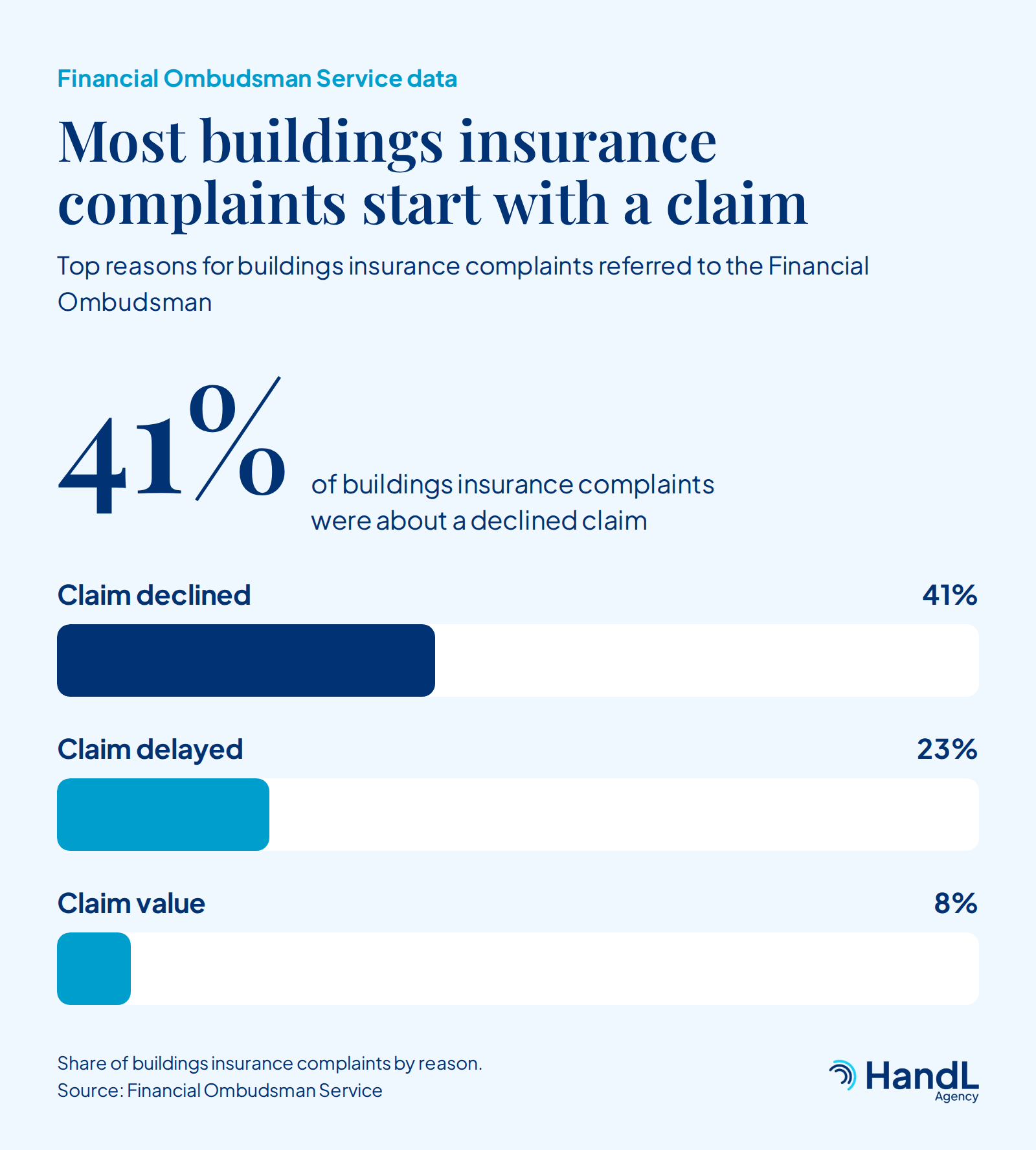
Claims are where clients feel service most, and where it most often fails. Almost 30,000 claims-related complaints were referred to the Financial Ombudsman in the 12 months to September 2024, 71% of all insurance complaints, and more than 40% were upheld in the customer’s favour. For buildings insurance, the top complaint reasons were claim decline (41%), claim delay (23%) and claim value (8%).
UK reviews of brokers and insurers repeat the same themes: calls not answered, emails ignored, callbacks that never come, and silence during a claim. AI fixes the admin backlog behind those complaints. It can track claims across insurers, chase loss adjusters for updates and draft clear progress emails for the broker to check and send, so the broker has time to pick up the phone.
AI-drafted claims updates can be better than manual ones. McKinsey reports one carrier uses AI to produce around 50,000 claims communications a day and finds them clearer and more empathetic than those written by people.
Client servicing and mid-term adjustments
AI can handle simple client requests and pass anything sensitive to a person. Use three tiers:
| Tier | Handled by | Example |
|---|---|---|
| 1 | AI answers from a knowledge base | “When does my policy renew?” |
| 2 | Automation completes the task | “Update my address and resend my documents” |
| 3 | A person, straight away | A claim dispute or complaint |
AI voice agents can now hold human-like conversations for FAQ calls using the same tiers. Every caller must be able to reach a person, and every AI conversation should be logged for review. Check UK consent rules (PECR) before using AI voice agents to call leads.
There’s a commercial case for out-of-hours cover too. McKinsey describes a carrier whose 24/7 chatbot led to an 11% increase in prospective customers going on to buy policies.
Inbox, admin and document processing
AI can sort the inbox before the team logs on. It can read and sort emails into clients, claims, new business and service, flag urgent ones and draft replies for a person to check. Document processing tools use optical character recognition and natural language processing to pull data from policy schedules and proposal forms into your document management system.
Meeting notes are another quick win. Your meeting note-taker can save notes, actions and follow-ups straight to the client record. Our meeting notes automation shows how.
Coverage gaps and cross-selling
AI can review a client’s existing policies and claims history to flag gaps in cover. The broker then raises them at renewal. It turns a renewal call from a price conversation into advice, and it helps the client find cover they didn’t know they needed.
Commission and insurer statements
AI can check commission received against commission expected, track revenue per insurer and flag missing insurer statements. It reads your trackers in Excel or Google Sheets and suggests changes, with your permission before anything is edited.
How much time can AI save an insurance broker?
The time saved depends on how manual your processes are today. These are the areas where HandL Agency typically finds time in a finance firm audit:
| Task | Before AI | With AI | Time reinvested in |
|---|---|---|---|
| Client follow-up email | 30 minutes | 5 to 10 minutes | Client calls |
| Renewal comparison | 45 to 60 minutes | 10 to 15 minutes | Renewal review calls |
| Insurer portal quote | 20 to 30 minutes per portal | 5 to 10 minutes per portal | Placement and advice |
| Meeting notes and CRM update | 15 to 20 minutes per meeting | 2 to 5 minutes per meeting | Prospecting |
| Document chasing | 15 to 20 minutes per client | Under 5 minutes per client | Claims support |
Are your clients already using AI?
Yes, and that changes the conversation before a client ever calls you. McKinsey cites research finding 29% of people who use gen AI tools such as ChatGPT use them for financial or investment information, advice or recommendations. Businesses and consumers are already uploading policy documents and commercial offers into ChatGPT for an independent view, and AI assistants are becoming the first voice explaining insurance value.
Clients will arrive having asked AI first. Your advice and your explanation of price need to be sharper than what they got from a chatbot. Your brokerage also needs to show up when they ask AI or Google for a broker, which is where SEO for insurance brokers comes in.
Which AI tools should insurance brokers use?
Insurance brokers should start with the AI tools they already pay for and add others only when a task needs them. The task matters more than the tool.
| Job | Tools | What it’s for |
|---|---|---|
| AI assistant | Microsoft 365 Copilot, Claude, ChatGPT | Drafting, summarising, research |
| Automation | n8n, Zapier | Fixed-step workflows |
| CRM | HubSpot, GoHighLevel, Salesforce | The central database everything connects to |
| Meeting notes | Fathom, Fireflies, Zoom | Notes and actions saved to the client record |
| AI voice agents | Vapi, ElevenLabs | FAQ calls and lead calls, after PECR checks |
If your brokerage runs on Outlook and Teams, Copilot sits inside the tools your team already uses. Claude suits heavier work, such as projects with your SOPs and connectors that link it to your inbox, files and CRM.
AI has to work around your existing insurance systems. Most brokers run a broking system such as Acturis, SSP, Applied Epic or Open GI, and many inherited legacy systems through acquisitions. Connect AI to what you already use rather than replacing it.
When choosing any AI platform or AI software, check:
- Data security: certifications, where data is stored, and whether it trains on your data
- Integration: whether it connects to your broking system, CRM and inbox
- Audit trail: whether every AI action is logged
- Pricing: whether costs spike at renewal peaks
- Lock-in: how easily you could switch. McKinsey lists supplier lock-in alongside security risks, legacy infrastructure and governance gaps as common barriers to scaling AI.
If you’d rather have it built for you, see how we deliver AI for insurance brokers.
How should insurance brokers write AI prompts?
Write prompts the way you’d brief a junior broker. The most common mistake is a one-line prompt with no context, a mediocre answer back, and the conclusion that AI is rubbish.
Treat AI like a junior employee. You wouldn’t tell a junior broker ‘do this task’ with no background or instructions and expect a perfect result. AI is exactly the same.
Bailey Wilshire

A good prompt has three parts: context, instructions and relevance.
Bad prompt:
Write a renewal email for my client.
Good prompt:
Context: I’m an account handler at a UK commercial insurance brokerage. The client is a [business type] with [number] staff. Their [policy type] renews on [date]. The premium is going up [X]% because [insurer’s reason].
Instructions: Write a renewal email that explains the increase in plain English, sums up what’s changed in cover versus last year using the details below, and invites them to book a 15-minute call. Under 200 words. British English. Don’t invent figures or cover details. If anything’s missing, put it in [square brackets]. Don’t recommend changes to cover.
Relevance: They’ve been with us [X] years and value a personal service. Warm, direct tone. No jargon.
Details: [paste expiring and renewal terms, with names and policy numbers removed]
Five more prompts brokers can copy:
- Policy schedule summary: “Summarise this policy schedule for a client in plain English: what’s covered, the main exclusions, the excess and the renewal date. Under 150 words. Flag anything unusual for me to check.”
- Renewal vs expiring comparison: “Compare these expiring and renewal terms in a table: premium, sums insured, excesses, exclusions and endorsements. Flag every change. Don’t judge whether changes are good or bad.”
- Document chase: “Write a short, friendly email asking a client for [documents] by [date] so we can finish their renewal. Explain in one line why we need them. Under 100 words.”
- Claims update: “Write a claims update for a client whose [claim type] claim is waiting on [insurer or loss adjuster action]. Say what’s happened, what happens next and when we’ll update them. Don’t promise an outcome.”
- Pre-call brief: “Research [company name, website] and give me a one-page brief before a call: what they do, size, likely insurance needs and three questions to ask. Only use what you can source, and list the sources.”
For more, download 25 AI Prompts Your Firm Will Actually Use, built for brokers, accountants and financial advisers. To make every client email sound like your brokerage, use our client email Claude skill guide.








Is it safe for insurance brokers to use AI?
Yes, if you use business-grade tools, keep client data protected and keep a person accountable. There’s no separate AI rulebook to learn. The FCA has said it won’t introduce new regulations for AI and will rely on existing frameworks, including the Consumer Duty, the Senior Managers and Certification Regime, and its expectations on governance and controls.
What that means for a broker:
- Consumer Duty: where AI shapes servicing or customer communications, firms should test outputs for fairness, suitability and foreseeable harm.
- SM&CR: firms should assign clear responsibility for approving AI use cases, managing data risk and overseeing third-party AI services.
- UK GDPR: where AI uses personal data, firms should line up their governance with data protection duties, including data protection impact assessments, transparency and human review of automated decisions.
- More guidance is coming. The FCA launched the Mills Review in January 2026 to examine how AI will reshape retail financial markets, and a parliamentary committee has recommended the FCA publish practical guidance on accountability for AI-related harm by the end of 2026.
Use plans that don’t train on your client data:
| Plan type | Trains on your data? | Suitable for client work? |
|---|---|---|
| Free and personal AI plans | Check the settings and switch training off | No |
| ChatGPT Business or Enterprise | Not by default | Yes |
| Claude Team or Enterprise | Not by default | Yes |
| Microsoft 365 Copilot | No: prompts, responses and Microsoft Graph data aren’t used to train foundation models | Yes |
Check each provider’s current terms before relying on them, as plans change.
What should brokers never put into an AI tool?
Never put client personal data, policy numbers, bank details, medical information or claims details into a free or personal AI tool. On business plans, still share the minimum the task needs. Strong data governance means giving each AI tool and connector the least access it needs, and keeping passwords and two-factor codes out of AI tools unless your compliance lead has signed it off.
How to check AI outputs before they reach a client
Check every figure against the source document, every cover detail against the policy schedule, and every statement about regulation against FCA guidance. Proofread before sending. Log the AI tasks you rely on so there’s an audit trail.
Where shouldn’t brokers use AI?
Don’t use AI to give advice, recommend cover or make claims decisions. Don’t put a chatbot or AI voice agent between a client and a person when something has gone wrong. Human oversight isn’t optional in a regulated firm: the broker stays accountable, not the software.
How do you get your team to actually use AI?
Getting the team to use AI is half the job. McKinsey estimates change management makes up half the effort needed to get value from AI, and recommends spending at least as much on adoption as on building the solution.
What works in a brokerage:
- Name an owner for each AI process
- Start with willing staff and let them show the rest of the team
- Train on real tasks, not theory
- Show the time saved in hours, not features
- Get one process right before starting the next
We get one process perfect and make sure everyone’s using it before we move on. Otherwise you end up with tools nobody touches.
Bailey Wilshire
What will an AI-powered brokerage look like in two years?
In two years, a brokerage using AI well will run sales, onboarding and document chasing as automated processes inside one CRM. AI agents will be trained on the brokerage’s clients, SOPs, insurer guidelines and branding, so anyone on the team can get an answer at any time.
The brokers in that firm won’t spend their days re-keying data. They’ll spend them on the phone with clients: talking through renewals, explaining cover and supporting people through claims. That’s the competitive advantage AI gives a brokerage. It doesn’t replace the personal service. It makes room for it.
Frequently asked questions
How long does it take to set up AI in a brokerage?
A first quick win, such as renewal reminders or inbox sorting, can be running within a few days. A full roadmap starts with a 30-day audit and is worked through one process at a time, usually over several months.
Is ChatGPT safe for insurance brokers to use?
ChatGPT is safe for client work on a Business or Enterprise plan, which doesn’t train on your data by default. Don’t put client personal data into a free or personal account, and check every output before it reaches a client.
What is agentic AI in insurance?
Agentic AI in insurance refers to AI agents that take a goal and complete several steps across your systems, such as qualifying a lead, updating the CRM and drafting a reply. In a brokerage, agentic AI should always stop at set points for a person to approve.
Can AI handle insurance claims for a broker?
AI can track claims, chase insurers and loss adjusters, and draft updates for clients. It shouldn’t make claims decisions or replace the broker’s call to a client. The broker stays the client’s main contact.
Do I need to replace my broking system to use AI?
No. Most AI tools connect to existing insurance systems through APIs, connectors or browser tools. Start with what you already use.
Should I tell clients I use AI?
Be open where AI interacts with clients directly, such as a chatbot or voice agent, which should say it’s AI and offer a route to a person. For AI used behind the scenes, such as drafting emails a broker checks, a line in your privacy notice is usually enough. Check with your compliance lead.
Do insurance agents and insurance brokers use AI the same way?
Yes. “Insurance agents” is the US term for what the UK calls insurance brokers, so most US guides to AI for insurance agents apply to UK brokers too. The difference is regulation. US insurance agents work under state rules, while UK brokers work under the FCA, Consumer Duty and UK GDPR. Use the same AI solutions, but check any compliance advice in US content against UK rules.
How does AI improve customer relationships at a brokerage?
AI improves customer relationships by giving brokers back the time that admin takes up. Manual data entry is slow and leads to errors, and every hour brokers spend re-keying data is an hour away from clients. AI can also analyse CRM records, client data and the tone of recent emails to flag who’s due a check-in, who’s gone quiet and where cross-selling makes sense. That makes customer interactions timely rather than reactive. The relationship building still happens on the phone, with the broker. AI means smaller teams can manage larger client books without losing the personal service behind a good customer experience.

Find out where AI fits in your brokerage
Take our free AI assessment. It takes a few minutes and shows where your brokerage sits on AI today, plus the first steps that would save the most time.
About the author
Bailey Wilshire is Director and Head of AI at HandL Agency, where he leads the AI audits and automation builds that give finance firms back the hours their teams lose to admin. He was on track to train as an accountant before moving into AI, so he knows how a finance firm runs from the inside. Before HandL Agency, he managed SEO for more than 20 UK businesses, including insurance firms, and built AI search strategies for national finance brands. He now maps brokerage workflows step by step to find where AI agents and automations save the most time.
Connect on LinkedIn: https://www.linkedin.com/in/bailey-wilshire/

Sources and methodology
Interview. Practical insights and quotes come from an interview with Bailey Wilshire in October 2026. Quotes are lightly edited for clarity.
Experience base. HandL Agency works exclusively with finance firms: accountants, bookkeepers, financial advisers and insurance brokers.
Statistics. Only figures from named, credited sources are included. Non-UK and insurer-level data is labelled as such. All statistics were checked in October 2026.
Product information. Plan names and data settings were checked against provider documentation in October 2026. Check current terms before relying on them.
Use of AI. This article was researched and drafted with AI assistance, then reviewed and edited by Bailey Wilshire and Luke Iles.
Updates. We review this guide quarterly.
Sources
- BIBA, About BIBA: https://www.biba.org.uk/about-biba/
- Insurance Business, BIBA turnover and London Economics research: https://www.insurancebusinessmag.com/uk/news/breaking-news/biba-reports-rise-in-turnover-as-investment-in-members-continues-to-pay-off-582226.aspx
- Insurance Business, BIBA conference talent poll: https://www.insurancebusinessmag.com/uk/news/breaking-news/talent-beats-ai-as-brokers-top-priority-biba-survey-finds-580422.aspx
- PKF, UK insurance broking pressures 2026: https://www.pkf-l.com/insights/uk-insurance-broking-pressures-2026/
- Insurance Times, AI and commercial insurance broking: https://www.insurancetimes.co.uk/analysis/briefing-ai-and-commercial-insurance-broking-existential-threat-or-strategic-opportunity/1457849.article
- Insurance Times, Ombudsman claims complaints: https://www.insurancetimes.co.uk/analysis/ombudsman-complaints-reveal-insurers-are-still-struggling-with-claims/1454255.article
- Financial Ombudsman Service, buildings insurance complaints: https://www.financial-ombudsman.org.uk/news/buildings-insurance-complaints-hit-10-year-high
- McKinsey, The future of AI in the insurance industry: https://www.mckinsey.com/industries/financial-services/our-insights/the-future-of-ai-in-the-insurance-industry
- Insurance Thought Leadership, The AI threat to insurance brokers: https://www.insurancethoughtleadership.com/agent-broker/ai-threat-insurance-brokers
- Harvard Business Review, The short life of online sales leads: https://hbr.org/2011/03/the-short-life-of-online-sales-leads
- Big “I”, independent agents and AI: https://www.independentagent.com/news/two-thirds-of-independent-agents-plan-to-increase-ai-use-this-year/
- FCA, AI in financial services: https://www.fca.org.uk/news/blogs/ai-financial-services-approach
- WilmerHale, AI and the UK FCA: https://www.wilmerhale.com/en/insights/client-alerts/20260429-ai-and-the-uk-financial-conduct-authority
- Ropes & Gray, the FCA’s expectations on AI governance: https://www.ropesgray.com/en/insights/viewpoints/2026/06/102n7e3/from-principles-to-practice-the-fcas-evolving-expectations-on-ai-governance
- Allianz and Anthropic partnership: https://www.businesswire.com/news/home/20260109004903/en/Allianz-and-Anthropic-Forge-Global-Partnership-to-Advance-Responsible-AI-in-Insurance
- Microsoft, enterprise data protection in Microsoft 365 Copilot: https://learn.microsoft.com/en-us/copilot/microsoft-365/enterprise-data-protection
- McKinsey, Aviva: rewiring the insurance claims journey with AI: https://www.mckinsey.com/capabilities/mckinsey-digital/how-we-help-clients/rewired-in-action/aviva-rewiring-the-insurance-claims-journey-with-ai
- Mortgage Solutions, Aviva rolls out AI for critical illness cover: https://www.mortgagesolutions.co.uk/mortgage-news/2026/03/18/aviva-rolls-out-ai-for-critical-illness-cover/
This guide is general information to help insurance brokers use AI tools. It isn’t legal, regulatory, data protection or financial advice.